NeurIPS 2026
Continuous-Time Single-Image-to-Video via Learning Deblurring and Blur-to-Video
One blurry photo, every moment inside it
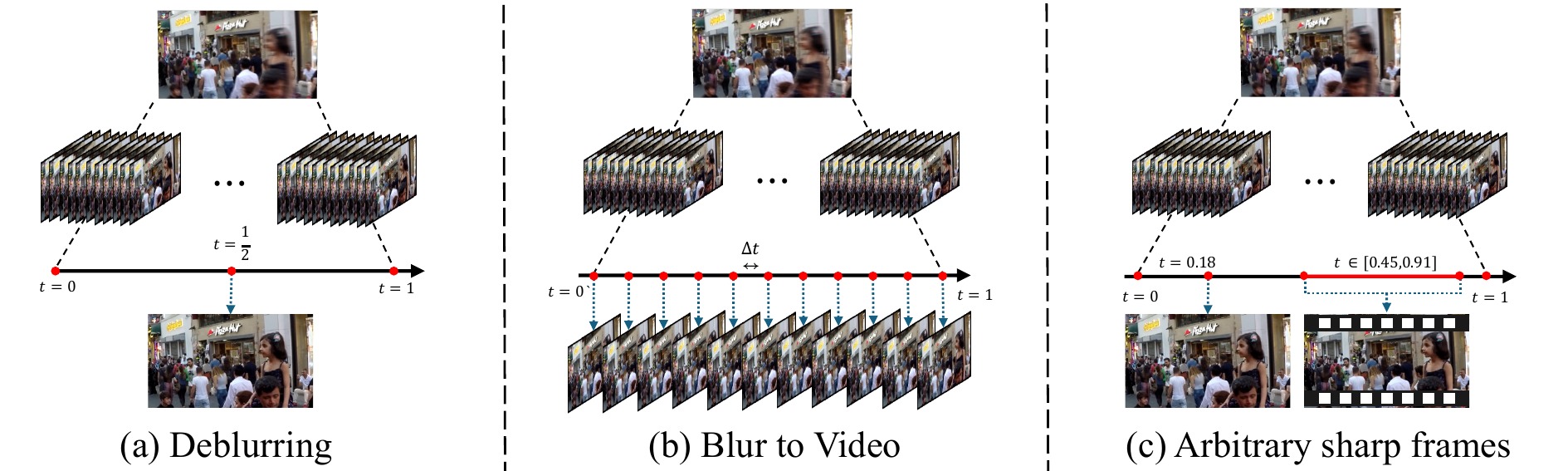
Drag along the exposure timeline. In moment mode the model returns the sharp frame $S(\tau)$ at the chosen instant; in interval mode it returns the interval-mean blur $B(s,t)$, i.e. the photo a camera would have taken had its shutter been open only from $s$ to $t$.
Abstract
Motion blur arises from the temporal integration of a continuous sharp signal over a finite exposure window, yet existing learning-based methods sidestep this physical model and predict only the sharp signal itself: most single-image deblurring methods recover a single frame at the exposure center, while blur-to-video methods predict a fixed set of frames. We introduce PickMoment, a continuous-time reformulation that directly learns the interval-mean blur over arbitrary sub-intervals of the exposure with a single deterministic model. Drawing an analogy to MeanFlow's average-velocity formulation, we train the model with three supervisions derived from the blur integral: an empirical reconstruction loss from available subframes, an additivity loss that enforces self-consistency across overlapping sub-intervals, and a sharp-frame loss anchored at the zero-interval limit. A single trained model unifies single-image deblurring, blur-to-video generation, and continuous-time pick-a-moment recovery as different queries to the same network, with no separate training for each task. Our PickMoment achieves state-of-the-art performance among generative-prior-based deblurring methods on GoPro and HIDE while competitive against restoration-based methods on RealBlur, and the highest per-frame fidelity on GoPro-7 blur-to-video, all with one forward pass per output frame and no iterative sampling.
Key idea
A motion-blurred photo is the average of the sharp scene over the exposure. PickMoment learns this averaging for every sub-interval, not only for the full exposure:
for any $0 \le s < t \le 1$ in normalized exposure time. The observed blurry image is $B(0,1)$, and as the interval shrinks, $B(s,t)$ converges to the sharp frame $S(\tau)$ at that instant. Every task becomes a query to the same network:
Method
The network $f_\theta$ is a diffusion transformer built on the FLUX.2-klein backbone, with a frozen VAE (encoder $\mathcal{E}$, decoder $\mathcal{D}$). The blurry input is encoded as $z_\text{blur} = \mathcal{E}(x_\text{blur})$, and $f_\theta(z_\text{blur}, s, t)$ predicts the latent of $B(s,t)$ as a residual added to $z_\text{blur}$. The interval replaces FLUX's original time conditioning: the triple $(s, t, t-s)$ is sinusoidally embedded, projected by a shared MLP, and injected through the same pathway as the original timestep. An image model thus solves a video task, with no video pretraining. Training uses three supervisions derived from the blur integral:
Results
| Method | PSNRp ↑ | SSIMp ↑ | LPIPSp ↓ | FVD ↓ | EPE ↓ |
|---|---|---|---|---|---|
| Jin et al. | 25.23 | 0.8190 | 0.084 | 235.53 | 3.38 |
| MotionETR | 26.54 | 0.8825 | 0.015 | 94.90 | 1.46 |
| Blur2Vid | 30.01 | 0.9359 | 0.012 | 21.46 | 0.39 |
| PickMoment (Ours) | 31.24 | 0.9388 | 0.0086 | 27.40 | 0.86 |
Bidirectional patch-based metrics following the Blur2Vid protocol. Baseline numbers are from the respective papers.
| Sequence | warp L1 | warp PSNR | vs. ground truth |
|---|---|---|---|
| Ground truth (natural motion) | 0.0096 | 35.23 | — |
| PickMoment (Ours) | 0.0089 | 36.49 | closest to GT |
| Blur2Vid | 0.0072 | 37.77 | smoother than GT |
| Jin et al. | 0.0106 | 34.52 | rougher than GT |
Each recovered frame is warped onto the next along RAFT flow and the photometric residual is measured, on all 1,744 GoPro-7 clips. PickMoment's frame-to-frame change matches natural motion, with no measurable flicker.
| $t/T$ | 0.000 | 0.125 | 0.250 | 0.375 | 0.500 | 0.625 | 0.750 | 0.875 | 1.000 | 33-pt mean |
|---|---|---|---|---|---|---|---|---|---|---|
| Blur2Vid | 21.31 | 20.30 | 19.99 | 22.92 | 21.46 | 22.47 | 21.95 | 21.53 | 21.30 | 21.60 |
| PickMoment (Ours) | 22.09 | 22.39 | 23.29 | 23.65 | 24.07 | 23.61 | 22.89 | 21.82 | 21.60 | 22.95 |
PSNR on X4K1000FPS (X-TEST, 15 clips). Each blur averages 33 consecutive 1000-fps frames, leaving ground truth at 33 timestamps per exposure. Both models are applied zero-shot from their GoPro-trained weights; PickMoment leads at every one of the 33 timestamps (9 shown).
Results · Single-image deblurring
Drag the slider to compare the blurry input with PickMoment's sharp frame at the exposure center (GoPro test set, full resolution).
| Method | GoPro | HIDE | ||||||
|---|---|---|---|---|---|---|---|---|
| PSNR ↑ | SSIM ↑ | LPIPS ↓ | DISTS ↓ | PSNR ↑ | SSIM ↑ | LPIPS ↓ | DISTS ↓ | |
| FideDiff | 28.79 | 0.9148 | 0.0831 | 0.0525 | 27.28 | 0.8775 | 0.1068 | 0.0647 |
| PickMoment (Ours) | 29.43 | 0.9253 | 0.0802 | 0.0429 | 27.52 | 0.8889 | 0.1043 | 0.0551 |
Comparison with FideDiff, the strongest generative-prior-based baseline. Across GoPro, HIDE, RealBlur-J and RealBlur-R, PickMoment is ahead on 12 of 16 metric cells; the full table with regression-based methods is in the paper. Deblurring uses the same model as blur-to-video, queried at $\tau = \tfrac12$.
Analysis
Same backbone, different target. With backbone, data and budget fixed, and only a latent reconstruction loss (no sharp-frame or perceptual loss), predicting the interval mean beats predicting a single sharp frame by 0.73 dB and a fixed set of $N$ frames by 0.69 dB in deblurring PSNR (0.62 / 0.52 dB in PSNRp).
Sharp-frame loss alone. Training with $\mathcal{L}_\text{sharp}$ only, so that no interval-mean supervision remains, nearly matches the full objective on deblurring but falls well behind on the video metrics. The formulation's contribution is temporal.
| GoPro | deblur PSNR | SSIM | LPIPS | DISTS | PSNRp | SSIMp | LPIPSp | FVD | EPE |
|---|---|---|---|---|---|---|---|---|---|
| $\mathcal{L}_\text{sharp}$ only | 29.06 | 0.9208 | 0.0812 | 0.0438 | 30.17 | 0.9186 | 0.0104 | 38.07 | 1.33 |
| Full objective | 29.43 | 0.9253 | 0.0802 | 0.0429 | 31.24 | 0.9388 | 0.0086 | 27.40 | 0.86 |
Citation
@inproceedings{shin2026pickmoment,
title={PickMoment: Continuous-Time Single-Image-to-Video via Learning Deblurring and Blur-to-Video},
author={Junseong Shin and Hyeonsu Jo and Daehyun Kim and Tae Hyun Kim},
booktitle={Advances in Neural Information Processing Systems (NeurIPS)},
year={2026}
}